
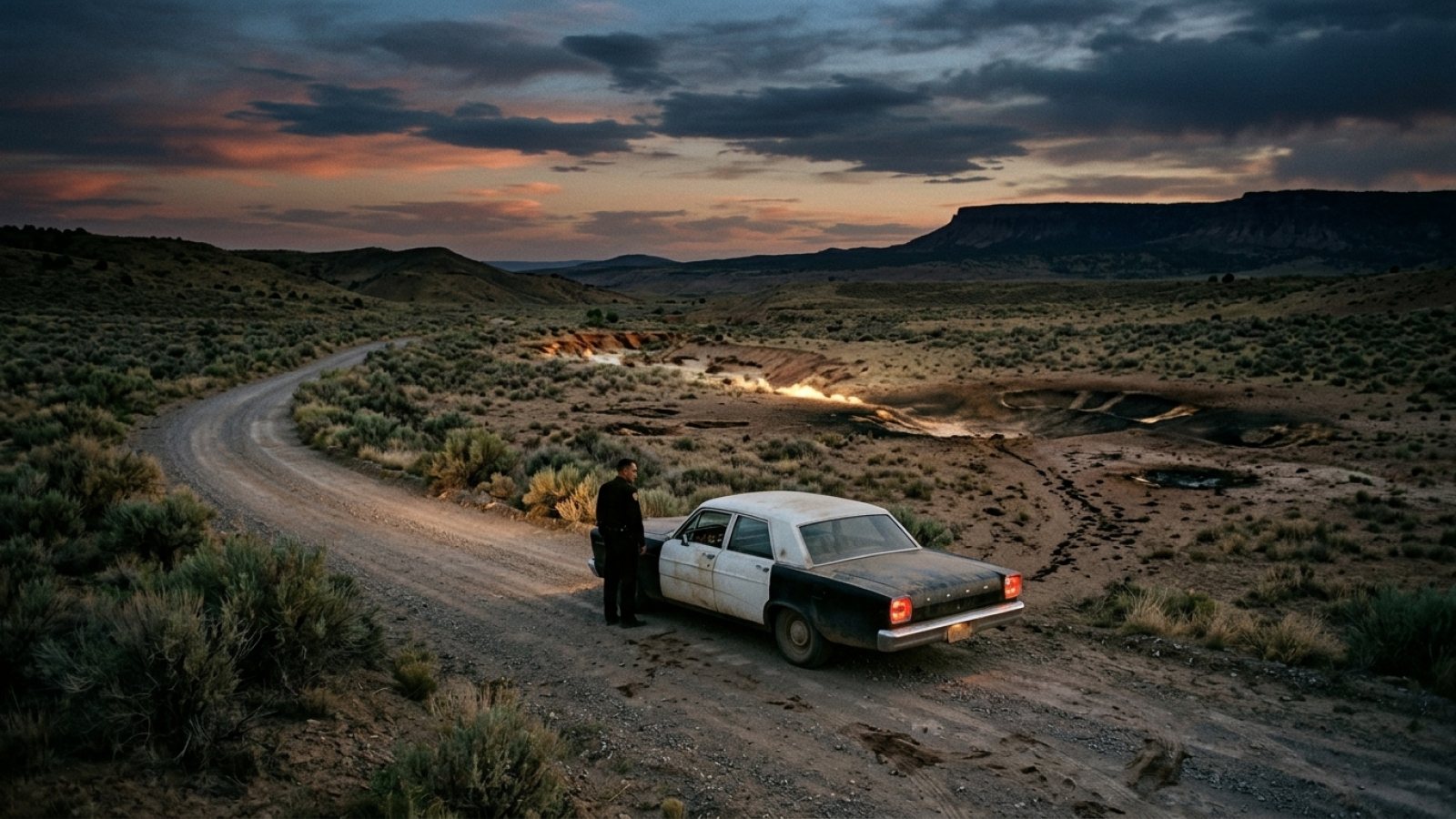
Lonnie Zamora at Socorro, April 1964: The Case Project Blue Book Left Unidentified
In 1964, patrolman Lonnie Zamora reported encountering an unknown craft and figures in Socorro, New Mexico. The incident, backed by physical evidence, became one of Project Blue Book's most perplexing and officially 'Unidentified' cases.
On the afternoon of April 24, 1964, patrolman Lonnie Zamora was pursuing a speeding car near Socorro, New Mexico, when he reported hearing a loud roar followed by a blue flame in the sky. Diverting his attention, he drove his police cruiser down a rough dirt road, observing what he initially took for an overturned vehicle but soon realized was something entirely different.
The Witness and the Scene
Zamora, a 31-year-old police officer with five years on the force, was known for his steady demeanor and excellent reputation within the Socorro community. On April 24, 1964, while pursuing a vehicle, he reported hearing a descending roar, unlike any jet he had encountered, followed by a flash of blue flame. He drove his police cruiser onto a rugged dirt track, observing what he initially took for an overturned car in a shallow arroyo, some 150 to 200 yards away. As he approached, Zamora reported seeing a smooth, “egg-shaped” object, about 12 to 15 feet long, resting on four legs. Beside it, he claimed to see two small figures in white coveralls, who seemed startled by his presence and quickly disappeared. Zamora reported attempting to radio his dispatcher, but experiencing difficulty. He said the object then emitted a low humming sound, followed by a rising roar and a fiery, blue-orange plume from its underside. It ascended rapidly, silent once airborne, and vanished into the sky. Crucially, Zamora noted a distinct red “chevron” or “V” shaped marking on its smooth side. Within minutes, Sergeant Sam Chavez, Zamora's superior, arrived after hearing Zamora's initial, excited radio call. Chavez found Zamora visibly shaken. Together, they immediately documented the physical evidence at the scene: four distinct, deeply impressed depressions in the sandy soil, consistent with landing gear, along with scorched patches of creosote brush where Zamora reported the flame. These findings were detailed in local police reports and quickly captured the attention of local and national media, including the El Paso Times and Associated Press, which published early accounts of the “Socorro saucer” landing.
Project Blue Book's Investigation
The Socorro incident's unusual nature quickly drew the attention of the U.S. Air Force's Project Blue Book, headquartered at Wright-Patterson Air Force Base and tasked with investigating UFO reports. Major Hector Quintanilla, Blue Book's director, along with scientific consultant Dr. J. Allen Hynek, an astronomer at Northwestern University, were dispatched to Socorro. Hynek conducted extensive, in-depth interviews with Zamora over several days, consistently finding him a credible and unwavering witness. His testimony remained consistent through multiple retellings, without embellishment. Investigators also meticulously examined the landing site, confirming the physical marks, scorch patterns, and impressions that seemed to indicate a heavy object had rested there. These ground traces presented a significant challenge to conventional explanation. Blue Book investigators considered a range of hypotheses, including an elaborate hoax, the misidentification of a known aircraft or experimental craft, or even natural phenomena. However, the integrity of the witness, the consistency of his account, and the tangible physical evidence made each conventional explanation seem inadequate. The remote location and the short timeframe between the reported landing and the arrival of Sgt. Chavez also made a hoax logistically difficult to execute. Major Quintanilla, in his summary of the case, openly acknowledged its perplexing nature. Ultimately, Project Blue Book officially classified the Lonnie Zamora sighting as “Unidentified,” a rare and significant designation for a case supported by both a reputable witness and strong physical trace evidence.
Legacy and Ongoing Disagreement
The Socorro incident quickly became one of Project Blue Book's most celebrated and debated cases, often cited as a benchmark in ufology due to the credibility of its witness and the corroborating physical evidence. Dr. Hynek, in his influential 1972 book, The UFO Experience: A Scientific Inquiry, categorized Socorro as a “Close Encounter of the Second Kind,” specifically because of the physical effects observed on the environment. Over the decades, the case continued to draw scrutiny from both proponents and skeptics. Some researchers argued that the details, particularly the distinctive ground traces and Zamora's consistent testimony, strongly suggested an unknown, perhaps advanced, craft. Skeptics, conversely, proposed various alternative explanations. Some theorized that Zamora might have misidentified a test flight of the Surveyor Lunar Lander, which was under development at the time, or perhaps a clandestine military experimental vehicle. Others suggested a sophisticated hoax, despite the challenges acknowledged by initial investigators. However, these counter-explanations often faced their own discrepancies when compared against Zamora's detailed account and the documented physical evidence. The Socorro story has been retold in numerous books, magazine articles, and television documentaries, each recounting shaping public perception and adding layers to its enduring mystery. Decades after the event, the detailed police reports and Project Blue Book files documenting the physical evidence and Zamora's consistent testimony remain, leaving the question of what truly transpired on that New Mexico afternoon open to interpretation and continued study in the public record.
