
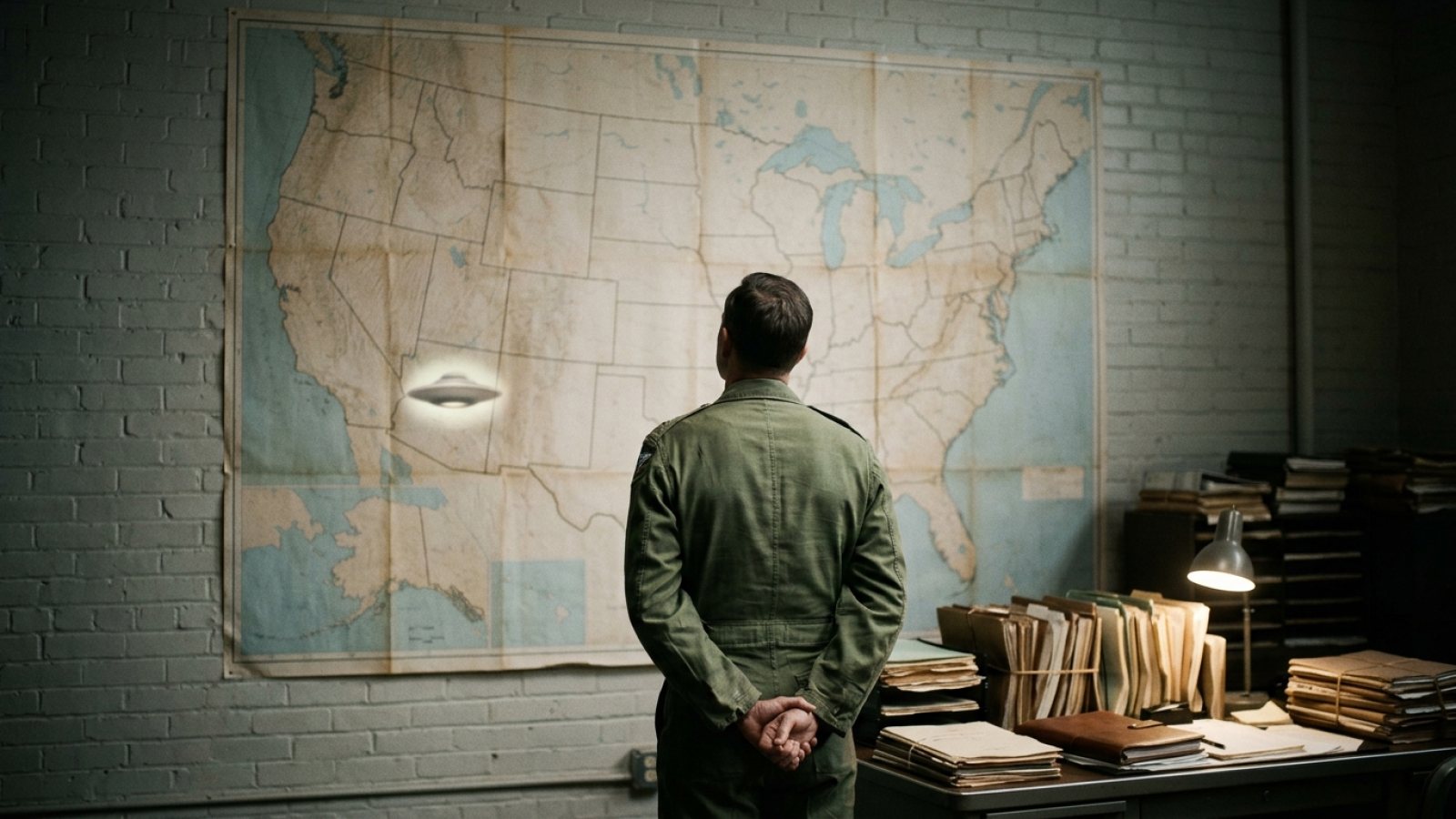
Project Sign, Grudge and Blue Book: The USAF's Two-Decade UFO Inquiry
For over two decades, the U.S. Air Force formally investigated unidentified aerial phenomena through Projects Sign, Grudge, and Blue Book. This extensive effort sought to understand what the public was reporting and assess any national security implications, leaving a complex legacy of documented cases.
In the wake of widespread aerial observations following Kenneth Arnold’s 1947 sighting, the United States Air Force initiated a series of projects to systematically investigate unexplained aerial phenomena. From 1948 to 1969, Project Sign, Project Grudge, and Project Blue Book formed the official U.S. government’s primary effort to understand these reports. This sustained, two-decade undertaking began with a genuine attempt to categorize and understand, evolved through periods of skepticism and public relations management, and ultimately concluded without resolving the mystery of a significant percentage of documented cases.
Project Sign: Initial Inquiry (1948-1949)
The first formal U.S. Air Force inquiry, Project Sign, was established in late 1948 at Wright-Patterson Air Force Base under the Air Materiel Command. Its stated mission was to collect, collate, evaluate, and distribute all information relating to unidentified flying objects, primarily to assess any potential national security implications. Early in its tenure, Project Sign produced a document titled the Estimate of the Situation. While the original document has never been publicly released, various accounts, notably from Dr. J. Allen Hynek—a scientific consultant to the projects—suggested it concluded that some UFOs represented actual craft of unknown origin, possibly extraterrestrial. However, according to these accounts, the Estimate was quickly suppressed by higher command, who reportedly ordered its destruction due to a perceived lack of hard evidence, replacing it with a more conservative assessment. Project Sign was short-lived, concluding in early 1949, its initial open-minded approach reportedly overshadowed by a desire for more conventional explanations.
Project Grudge: The Debunking Turn (1949-1951)
Project Grudge succeeded Sign in February 1949, carrying forward the Air Force’s investigative mandate but with a distinctly different posture. From its inception, Grudge operated with a predisposition to explain away sightings as conventional aircraft, astronomical phenomena, hoaxes, or psychological misperceptions. Its stated purpose remained to collect and evaluate information, yet its methodology often aimed to debunk, rather than explore. The project’s single public report, Project Grudge Report No. 13, published in December 1949, concluded that there was no evidence of advanced technology or extraterrestrial visitation. It asserted that most reported UFOs were explainable as conventional objects or phenomena, recommending that the Air Force reduce its efforts in this area. This dismissive stance, while offering a clear official position, generated criticism from civilian researchers who argued that the explanations often failed to fully account for witness testimony and documented details. Project Grudge, like its predecessor, was relatively brief, officially closing in late 1951.
Project Blue Book: Extended Investigation and Official Closure (1952-1969)
Amid renewed public interest and a notable wave of sightings, including those over Washington D.C. in the summer of 1952, Project Grudge was reconstituted as Project Blue Book in March 1952. Headquartered at Wright-Patterson AFB, Blue Book became the longest-running and most public of the Air Force’s UFO investigations, continuing until December 1969. Its dual objectives were to determine if UFOs posed a threat to U.S. security and to scientifically analyze UFO data.
Early leadership under Captain Edward J. Ruppelt saw an attempt to implement more rigorous scientific standards and a commitment to objective analysis. Ruppelt even coined the term "UFO." However, the project's direction was significantly influenced by external factors. In 1953, the Central Intelligence Agency convened the Robertson Panel, which reviewed Blue Book’s findings and recommended a policy of public debunking and education to reduce public interest in UFOs, perceiving it as a potential national security vulnerability. This recommendation arguably shifted Blue Book’s focus towards explaining away sightings rather than purely investigating them.
Throughout its existence, Blue Book investigated over 12,000 sightings. While the vast majority were identified as conventional aircraft, weather balloons, satellites, or natural phenomena, a persistent percentage—around 6% to 20% depending on the period—remained 'unidentified.'
In its later years, the controversy around Blue Book's methods and conclusions led the Air Force to commission an independent scientific study: the University of Colorado UFO Project, known as the Condon Committee. From 1966 to 1969, under Dr. Edward U. Condon, this committee conducted its own research. Its final report, published in 1969, concluded that further study of UFOs was unlikely to yield results commensurate with the resources required, finding no evidence that UFOs were extraterrestrial vehicles or represented a threat. The Condon Report’s conclusions were disputed by some scientists, including Dr. Hynek, who pointed to methodological flaws and specific cases that remained unexplained. Nevertheless, based on the Condon Committee’s recommendations and a diminishing perception of national security threat, the Secretary of the Air Force announced the termination of Project Blue Book on December 17, 1969.
The official record of these projects underscores a complex history of military engagement with unexplained aerial phenomena. While the Air Force ultimately closed its formal UFO investigations citing a lack of compelling evidence, the reports and testimonies collected over two decades documented a consistent pattern of observations that defied easy explanation, leaving a substantial archive of unresolved cases for future examination.
