
The Robertson Panel (1953): A CIA Review That Shaped Official UAP Policy
In January 1953, a secret CIA-convened panel reviewed UFO sightings, concluding they posed no direct threat but recommended a public debunking campaign. Its findings profoundly influenced subsequent government engagement with unexplained aerial phenomena for decades.
In the tense geopolitical climate of the early Cold War, a dramatic increase in unidentified flying object (UFO) reports, including a notable wave over Washington D.C. in the summer of 1952, prompted significant concern within U.S. intelligence circles. The Central Intelligence Agency (CIA), specifically its Office of Scientific Intelligence, began to assess the national security implications of these phenomena, not for their potential extraterrestrial origin, but for the risk they posed to air defense systems and public order. This concern ultimately led to the convening of a pivotal, short-lived panel that would shape official U.S. government policy on UFOs for decades.
The Secret Review
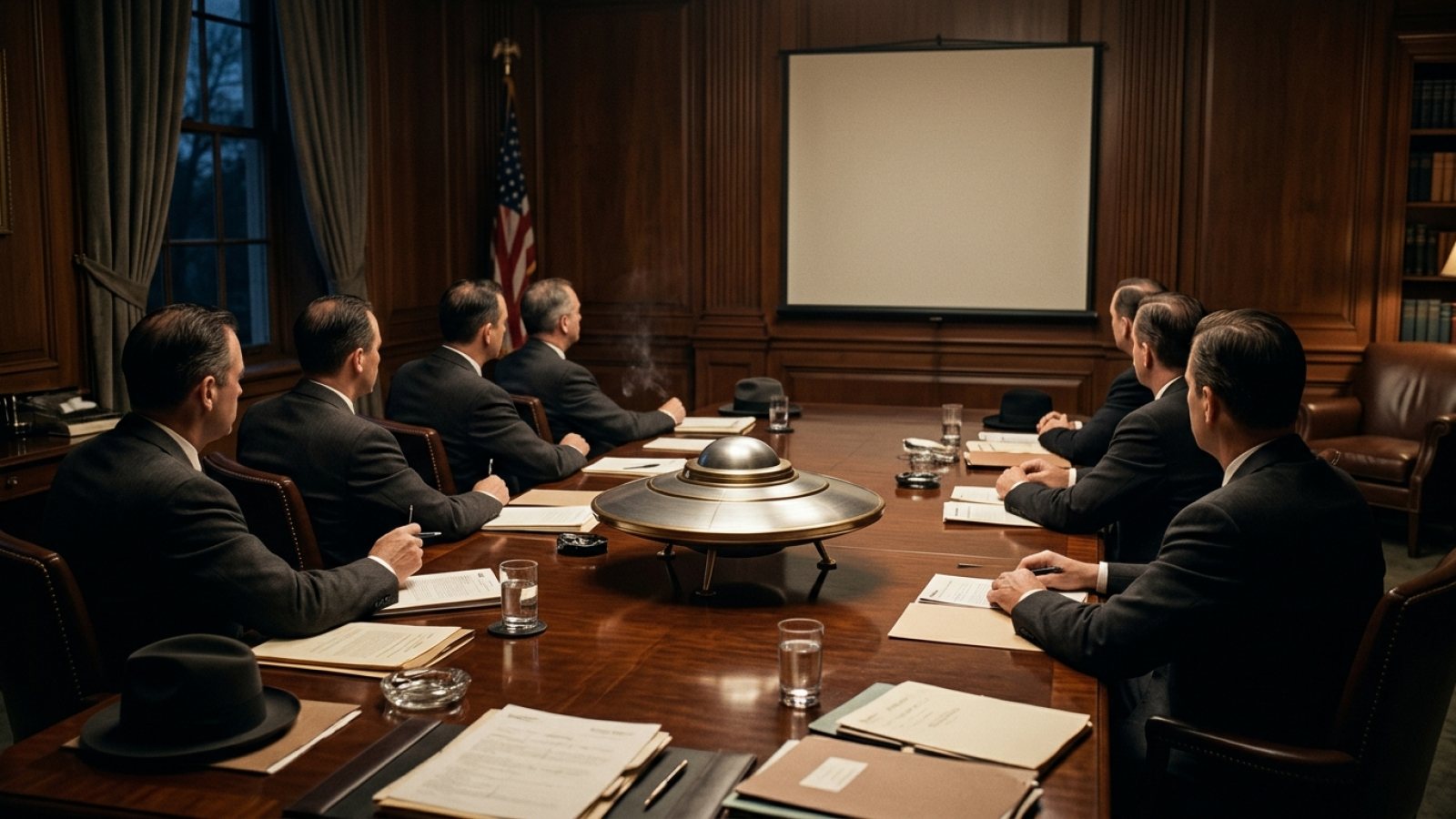
On January 14, 1953, a group of prominent scientists gathered in Washington D.C. at the behest of the CIA. Chaired by Dr. H. P. Robertson, a physicist from the California Institute of Technology, the panel included other distinguished figures such as Dr. Luis Alvarez, Dr. Lloyd Berkner, Dr. Samuel Goudsmit, and Dr. Thornton Page. Dr. J. Allen Hynek, an astronomer and scientific consultant to the U.S. Air Force's then-active *Project Blue Book*, was present to brief the panel on the project’s findings and specific cases. Over four intensive days, concluding on January 18, 1953, the panel reviewed select cases from *Project Blue Book*, including photographic and radar evidence, and heard testimony from military and intelligence personnel. Its task was to evaluate the national security aspects of the UFO phenomenon.
The panel's documented findings concluded that there was no direct evidence that UFOs constituted a physical threat to national security or showed any hostile intent. Furthermore, they found no evidence to suggest that the objects observed were extraterrestrial in origin. The panel's report stated that the vast majority of sightings could be readily explained as misidentification of conventional objects such as balloons, aircraft, or celestial phenomena, or as the result of psychological factors. However, the panel identified a different, significant threat: the potential for public panic or mass hysteria, and the risk of overwhelming military communication channels with spurious reports, particularly during a national emergency. This, they concluded, could be exploited by an adversary.
Recommendations and Their Immediate Impact
Based on their assessment, the Robertson Panel put forth several key recommendations. Central among these was the urgent need for a public education program designed to "strip the 'saucer' of its aura of mystery." The panel advocated for a comprehensive debunking campaign, urging governmental agencies to actively diminish public interest in UFOs. This program was to utilize mass media—such as television, film, and popular articles—to explain away prominent sightings with conventional explanations. Furthermore, the panel recommended that national security agencies should watch civilian UFO research groups closely, considering them potentially subversive if their activities fostered public alarm or contributed to a vulnerability in national defenses by diverting resources.
These recommendations were not merely suggestions; they were adopted and profoundly influenced the U.S. government's official stance on UFOs for the following decades. *Project Blue Book* subsequently shifted its operational focus, adopting a more aggressive policy of explanation and dismissal for incoming reports. The stated goal was to reduce the volume of unexplained cases and, by extension, public interest and concern. This approach aimed to manage public perception and prevent any perceived national security risks from widespread belief in unknown aerial phenomena.
A Lasting Legacy
The Robertson Panel's report, initially classified, was eventually declassified and made public, becoming a foundational document in the history of ufology. Its recommendations set a precedent, framing the UFO phenomenon primarily as a public relations and national security management issue rather than a purely scientific inquiry. For many civilian UFO researchers and advocacy groups that emerged in the years following, the panel's findings and recommendations were interpreted as an official effort to suppress legitimate investigation or even to conceal a deeper truth. These groups often claimed the panel's advice led to a culture of secrecy and dismissal.
Notably, Dr. J. Allen Hynek, who briefed the panel, later reflected on its impact, expressing regret that the panel had seemingly prioritized public debunking over sustained scientific inquiry. His views evolved considerably over time, leading him to become a vocal critic of the dismissive official approach he had once helped to inform. The Robertson Panel, in its assessment of available data and its strategic recommendations, fundamentally shaped the discourse surrounding UFOs in the United States. While the official approach to unexplained aerial phenomena has evolved through programs like AATIP and AARO, moving towards greater transparency and scientific rigor, the panel's core recommendations left an indelible mark on how the U.S. government publicly engaged, or disengaged, with the topic of unidentified flying objects for generations.
