
Roswell, July 1947: The Press Release, the Retraction, and Five Decades of Retelling
A July 1947 press release from the Roswell Army Air Field reported the recovery of a 'flying disc,' only for it to be retracted swiftly as a weather balloon. This event, initially dismissed, would re-emerge decades later to become one of ufology's most enduring and debated narratives.
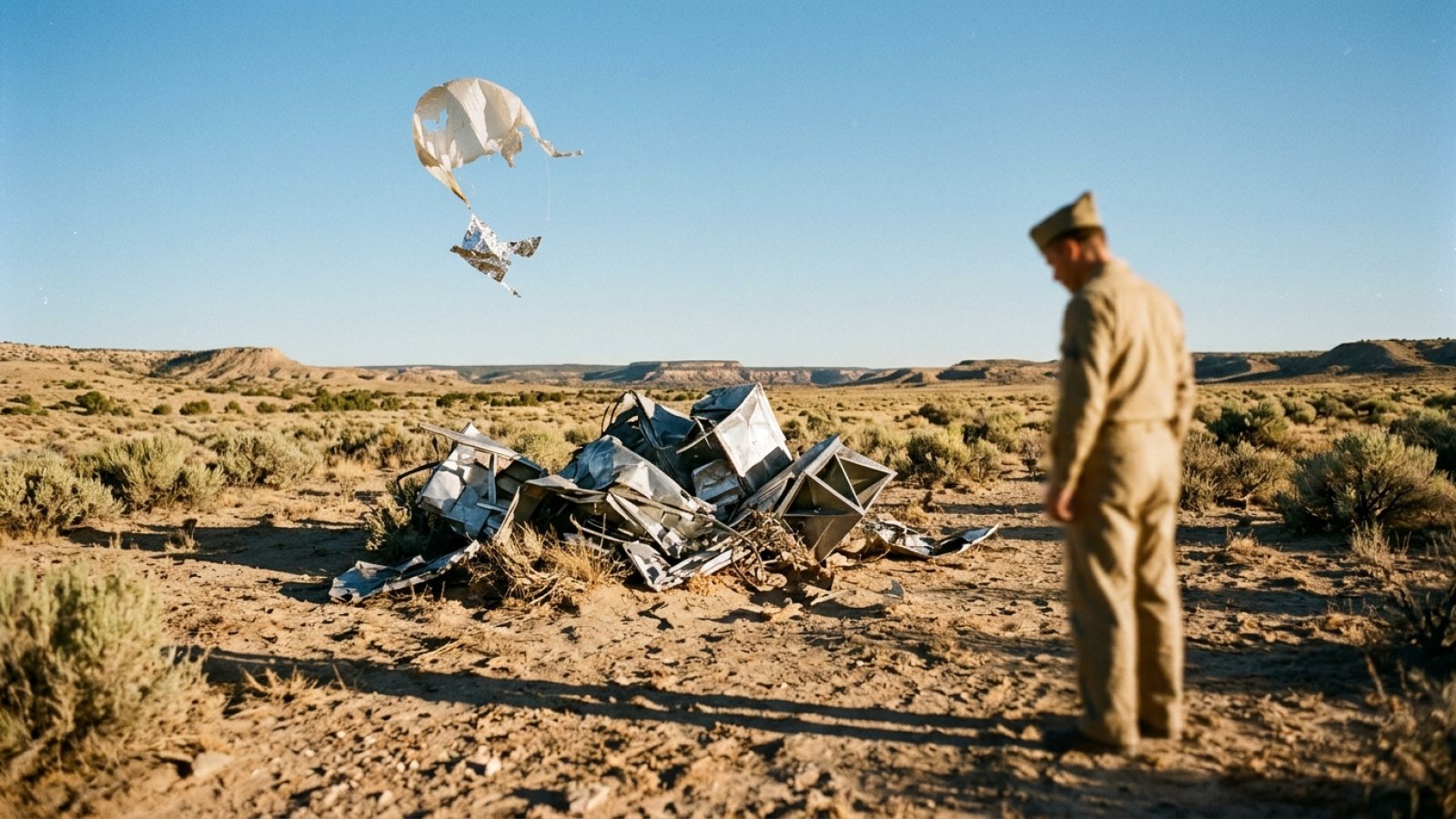
On July 8, 1947, a headline from the Roswell Daily Record declared, "RAAF Captures Flying Saucer On Ranch in Roswell Region." This announcement, issued by Lieutenant Walter Haut, the public information officer for the Roswell Army Air Field (RAAF) in New Mexico, stated that intelligence officer Major Jesse Marcel had recovered a "flying disc" from a rancher's property. The statement detailed that the RAAF had taken possession of the object, promising further examination and a more detailed report.
The press release ignited immediate national interest, with news agencies quickly picking up the story. Local radio stations and newspapers echoed the RAAF's claim, momentarily cementing the idea of a captured unidentified flying object in the public consciousness. However, the official narrative was about to undergo a dramatic and swift reversal, setting the stage for decades of speculation.
The Official Retraction
Within hours of the initial announcement, military authorities at a higher level intervened. On the same day, Brigadier General Roger Ramey, commander of the Eighth Air Force headquartered in Fort Worth, Texas, held a press conference. There, he publicly identified the recovered debris as a conventional weather balloon and its associated radar target. Photographs were taken showing General Ramey and Major Marcel examining remnants which appeared to be tinfoil, rubber, and balsa wood. The official explanation was disseminated rapidly, and the media, which had initially reported a captured flying saucer, now reported a misidentified weather balloon.
This retraction largely curtailed mainstream public discussion of the incident for decades. The official stance was clear: there was no captured "flying disc." The debris, according to the military, was merely the remains of a standard weather instrument. For contemporary news reports, the matter appeared closed, relegated to a brief, if sensational, footnote in the summer of 1947. The Roswell Daily Record, which had heralded the flying saucer capture, ran a subsequent story reporting the weather balloon explanation.
A Story Retold: From Obscurity to Controversy
The Roswell incident remained largely dormant until the late 1970s, when new interest from civilian researchers began to unearth additional witness testimony and re-examine the original events. Leading this re-examination was nuclear physicist and ufologist Stanton Friedman, who extensively interviewed individuals connected to the 1947 event, including Jesse Marcel. Friedman, along with Charles Berlitz, co-authored The Roswell Incident (1980), a book that argued for a cover-up and introduced claims of exotic materials and advanced technology found at the site.
Subsequent investigations by researchers like Kevin Randle and Donald Schmitt, detailed in books such as UFO Crash at Roswell (1991), gathered further witness accounts. These later accounts, attributed to various individuals who claimed to have been involved or had knowledge of the event, expanded on the initial "flying disc" claims to include descriptions of alien bodies and the recovery of non-terrestrial technology. These narratives presented a stark contrast to the initial 1947 official explanation and invigorated public interest, portraying the Roswell incident as evidence of a government cover-up of extraterrestrial visitation.
Official Responses and Lingering Questions
In response to the renewed public and political pressure, the United States Air Force launched two comprehensive investigations into the Roswell claims. The first, The Roswell Report: Fact vs. Fiction in the New Mexico Desert, published in 1995, concluded that the debris recovered by the RAAF in 1947 was consistent with a Project Mogul balloon array – a then-secret high-altitude balloon project designed to detect Soviet nuclear tests. This report directly addressed the materials described by Marcel and others, aligning them with components of a Mogul balloon.
A second report, The Roswell Report: Case Closed, followed in 1997. This report specifically addressed the later claims of "alien bodies" and the alleged recovery of extraterrestrial beings. It concluded that these claims were likely a combination of misidentified anthropomorphic test dummies used in high-altitude parachute recovery tests (Operation HIGH DIVE), conducted in the 1950s, and the conflation of these later events with the original 1947 incident. Witnesses, the report suggested, may have either misremembered or combined details from different events separated by years.
While the Air Force reports provided detailed explanations for both the debris and the alleged bodies, attributed to secret government projects, a segment of researchers and the public continue to dispute these conclusions. The official explanations, they argue, do not fully reconcile all witness testimonies or address perceived inconsistencies. The Roswell incident, therefore, remains a complex tapestry of initial press reports, swift official denials, and decades of accumulating claims and counter-claims, with no single account satisfying all parties.
