The Washington, D.C. Radar Sightings of July 1952 and the Press Conference That Followed
In July 1952, unexplained radar targets appeared over Washington D.C., leading to scrambles of Air Force jets and an unprecedented Pentagon press conference. This event brought the UFO phenomenon directly to national attention.
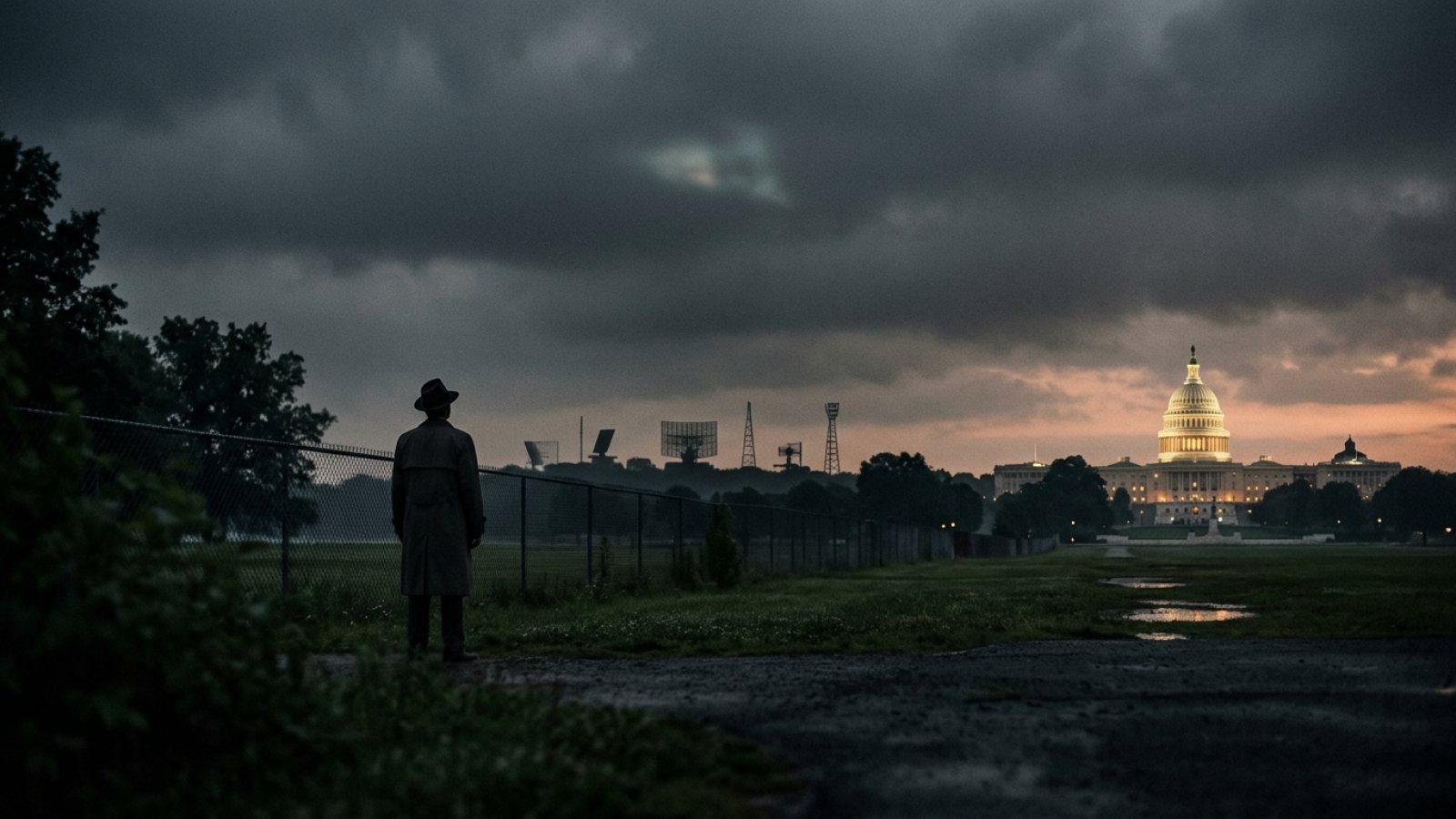
On the humid night of July 19, 1952, a chilling phenomenon began to unfold on the radar screens of Washington National Airport (now Ronald Reagan Washington National Airport), sparking an event that would bring the UFO question to the highest levels of the United States government.
The Radar and The Skies of July 19th
At approximately 11:40 PM EDT, Edward Nugent, a senior air traffic controller, observed seven distinct, unidentified targets moving erratically on his radar scope. The objects appeared to be moving slowly in some instances, then accelerating rapidly to estimated speeds of several thousand miles per hour, making abrupt turns, and often disappearing and reappearing from the radar screen. These observations were quickly corroborated by other controllers at Washington National, including Harry Barnes. The targets were also reportedly confirmed by military radar at Andrews Air Force Base and the Air Route Traffic Control Center in Washington.
As the objects continued to be tracked, civilian authorities contacted military officials. By 1:30 AM on July 20, two F-94 Starfire jet interceptors from Newcastle Air Force Base, Delaware, were scrambled. First Lieutenant William Patterson, one of the pilots, later reported that he saw four bright white lights that he could not identify, but that vanished when he attempted to approach them. Air Force reports stated that the visual sightings were inconclusive, with some pilots seeing lights but unable to identify them, and others seeing nothing unusual. The radar targets reportedly disappeared around 5:00 AM.
A Second Weekend, A National Story
The events of July 19-20 garnered significant press attention, with the Washington Evening Star and other outlets running front-page stories. Just a week later, on the night of July 26-27, 1952, the radar and visual phenomena reappeared over Washington D.C. This second wave of sightings followed a similar pattern, with radar operators at multiple facilities again tracking fast-moving, unidentifiable objects. More F-94 jets were scrambled. Captain John W. Case, a pilot, reported chasing several lights that evening, describing them as moving in erratic patterns inconsistent with known aircraft.
The repeated incidents over the nation's capital created a media frenzy and heightened public concern. President Harry S. Truman reportedly contacted his Air Force aide about the sightings. This pressure prompted the U.S. Air Force, then responsible for investigating UFO reports through Project Blue Book, to respond publicly. The Director of Air Force Intelligence, Major General John Samford, decided to hold an unprecedented press conference, the largest since World War II, to address the unfolding situation.
The Pentagon's Public Response and Lingering Questions
On July 29, 1952, Major General Samford, joined by Major Edward J. Ruppelt, the head of Project Blue Book, addressed a room full of reporters at the Pentagon. General Samford stated that the radar sightings were likely due to a temperature inversion layer, a meteorological condition where a layer of warm air traps cooler air below it, bending radar waves and creating false returns. He asserted that visual sightings of "lights" could be attributed to misidentified celestial objects or ordinary aircraft. Ruppelt supported this explanation, emphasizing the complexity of radar operations and the potential for anomalous propagation.
Project Blue Book's official conclusion, published in their report on the incident, attributed the radar sightings to temperature inversions and the visual sightings to misidentified stars, meteors, and conventional aircraft. However, this explanation did not entirely satisfy all witnesses or later researchers. Critics pointed to the erratic movements reported by radar operators, the high speeds, and the instances where visual sightings occurred simultaneously with radar contacts as inconsistent with a simple inversion phenomenon. Some researchers argued that while inversions could account for some radar anomalies, they struggled to explain the coherent, intelligent-seeming maneuvers reported or the specific visual observations made by pilots and ground personnel.
While the official explanation of temperature inversions was issued, the comprehensive nature of all the reported radar anomalies and visual observations from those two July weekends remains a subject of ongoing historical review and discussion within the ufological record.
